

Pre-living
Why some of us live in next Tuesday before it arrives.

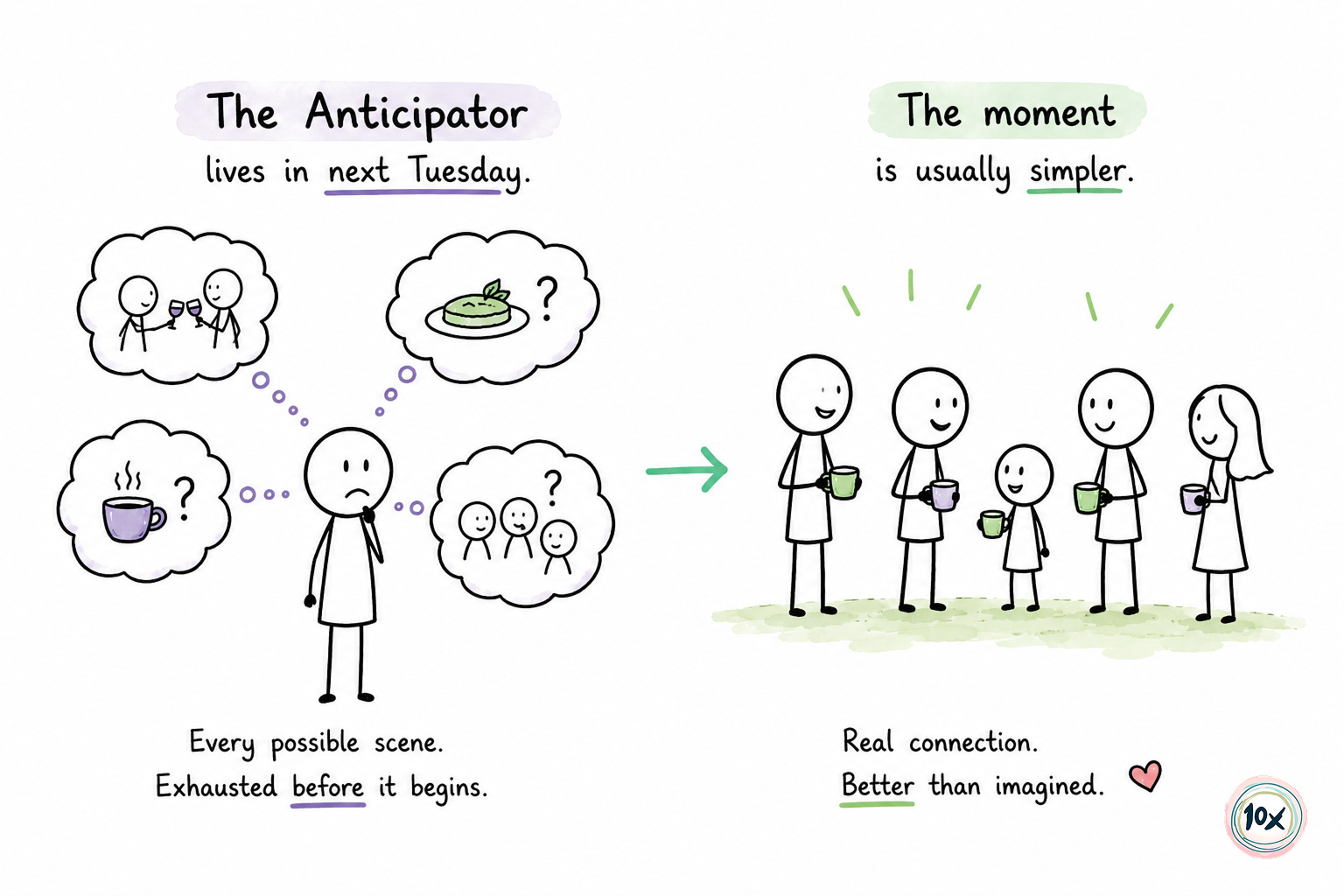
A friend I hadn’t seen in 15 years was coming to Singapore for 10 days. I was excited. I was also exhausted, and she hadn’t landed yet. I was imagining all kinds of scenarios…
She’ll want a girls’ drinking night out, and I’ll have to say I quit two years ago. She’ll suggest local cuisine, and I’ll have to mention I’m a vegetarian. She’ll remember our ‘chai’ fueled chats from college, and now my mornings are a slow coffee-grinding ritual she might find dull. She’ll find the sourdough baking too earnest. The no-dessert thing too boring.
What if she goes back disappointed? What if she doesn’t click with my husband, or my kids? What if our wavelengths have drifted too far?
She hadn’t even landed yet, and my brain had already played out every scene.
This is the Anticipator. The overthinker who lives in next Tuesday before it arrives.
If you’re one, you know the move. Something is on the horizon, a difficult conversation, a presentation, a meeting, a guest arriving, and your mind starts running it. You imagine what they’ll say. You imagine your response. You imagine their response to your response. You feel the dread, or the tension, or the relief, hours or days before the actual moment.
You arrive exhausted at a thing that hasn’t started yet.
Why our minds do this
The Anticipator pattern isn’t a flaw. It’s an adaptive function on overdrive.
Mental rehearsal is useful. Our ancestors survived because they could simulate the next move before making it. The brain that could imagine what if the lion is behind that bush stayed alive longer than the brain that walked into the bush.
The system was built for one thing: simulate a scenario quickly, decide, act.
It wasn’t built to run the same scenario nineteen times. Or three different scenarios for the same event. Or to keep rehearsing after a decision is already made.
This is where Anticipators get stuck. Not in the simulation. In the loop.
The disguise
The reason Anticipators rarely catch themselves is that pre-living looks like preparation.
You’re not being anxious. You’re being thoughtful. You’re not worrying. You’re being prepared. You’re not stuck in your head. You’re being responsible.
This is true for the first pass. The first time you think about Thursday’s conversation, you’re planning. It’s useful.
The second pass is review. Still useful.
The fifth pass is rumination dressed up as planning.
The trap is that each loop feels productive in the moment. It’s only at the end of the week, when you’re tired and the conversation went nothing like you imagined, that you notice you spent five hours pre-living a five-minute exchange.
Three signs you’re pre-living, not planning
❶ The same scenario is running for the third time, and you’re not learning anything new.
❷ You’re not asking what should I do? You’re asking what will they say? Planning is about your next action. Pre-living is about predicting their reaction.
❸ You can feel the emotion of the future event right now, in your body. The pit in your stomach, the tightness in your chest. That’s the giveaway. Your nervous system can’t tell the difference between rehearsing the conversation and having it.
A small interruption
When you catch yourself in a third or fourth pass, try this.
Write down, in one sentence, what you’ve actually decided.
Not what they might say. What you will do.
If you can write it, the planning is done. The rest is loop, and the loop will give you exactly nothing new.
If you can’t write it yet, you’re not pre-living. You’re still planning. Keep going. One more pass.
Most of the time, though, you can write it. You’ve known what you’re going to do for hours. Your mind just kept rehearsing the surroundings.
The reframe
Anticipators are often told to “stop worrying” or “be present.” That advice misses the mechanic.
You’re not failing at being present. You’re running an old survival system at the wrong scale.
A useful question, mid-spiral: Am I deciding, or am I rehearsing?
Ten minutes after my friend walked in, all five of us were laughing. She had energy you don’t expect from someone who just got off a five-hour flight.
That night, my teenage daughter pulled me aside: “Your friend is so cool.” (If you have a teenage kid, you know what a rare compliment that is.)
My friend turned out to be a coffee buff. She’d brought freshly roasted beans as a gift. We walked on the beach. We watched the Singapore Flyer light up. We went to a ‘first-day-first-show’ movie together. The last one had been There’s Something About Mary, during college days fifteen years ago. This one, a new release at a Singapore cineplex. Same ritual. ❤️
None of the scenes my brain had rehearsed actually happened.
Not one.
P.S.: This is the first of three deep dives on the three types of overthinkers I wrote about last month. Anticipator this week, Loop Thinker next, Stuck Decider after. If you had an Anticipator moment this week, hit reply and tell me. I'm collecting stories.
So aptly put together