

The friend prompt
A one-question tool for people who are better at advising than deciding

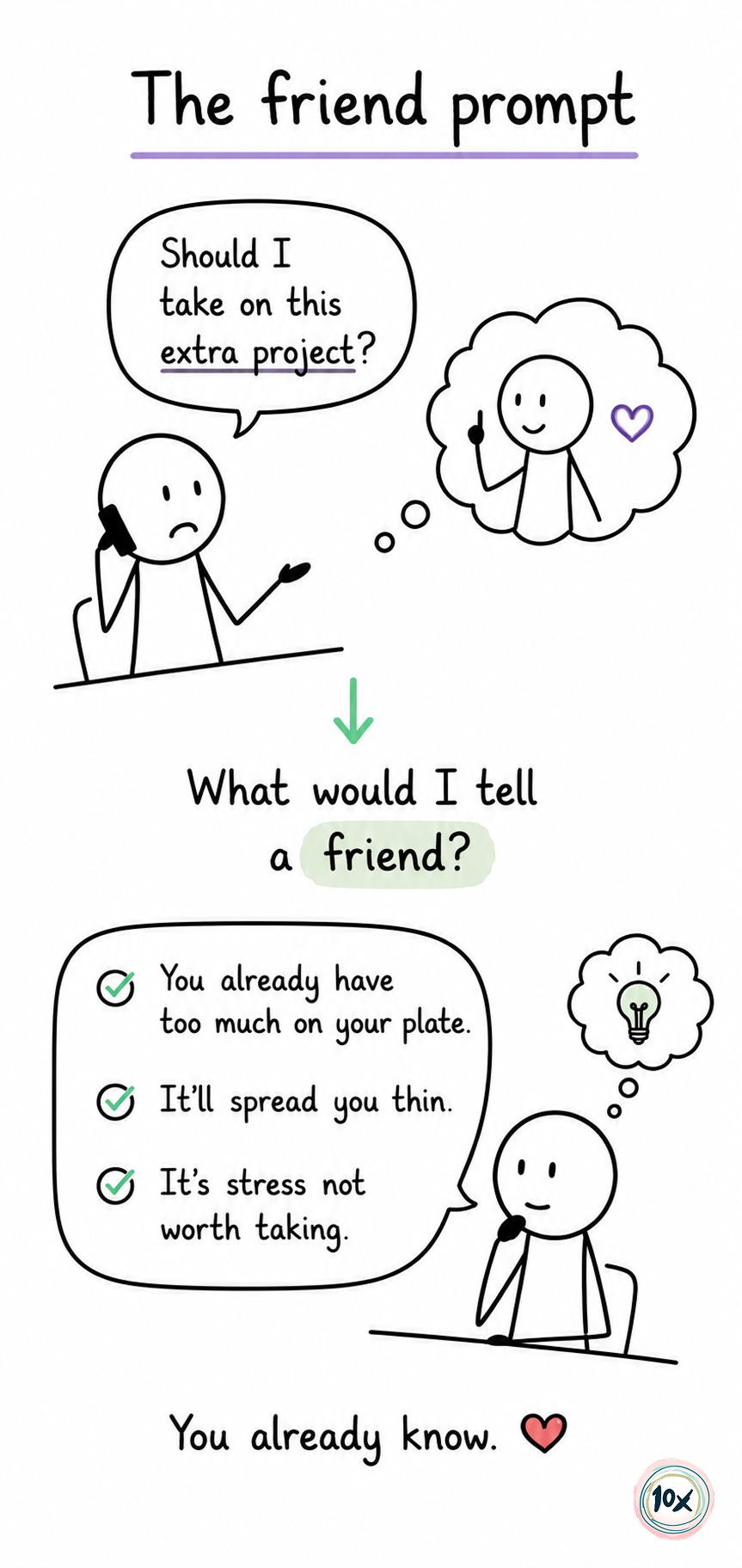
A friend called me last week with a decision she needed help making. Should she take on an extra project that might put her in a good position at work? We talked it through. My suggestion, in the end, was along these lines: “You already have too much on your plate.” “It’ll spread you thin.” “It’s not worth the stress.”
She listened, agreed, hung up. I sat back down at my desk and stared at the extra project I was considering saying yes to. I’d been agonizing over it for over a week. I had just given my friend the answer I wouldn’t give myself.
The odd truth about being human: you’re much better at solving other people’s problems than your own.
Not because you’re wiser than the people you advise. Not because their problems are simpler.
When it’s someone else’s problem, your brain treats it as a puzzle to solve. When it’s yours, your brain treats it as a threat to defend against.
It’s the same brain, same information. Just a different mode when we’re advising others.
The gap between the two modes is enormous. Once you notice it, you can use it deliberately.
The tool
When you’re stuck on your own decision, ask one question:
What would I tell a friend if they were in this situation?
Write your problem down as if a friend is describing it to you. Change “I” to their name. Get specific. Then write the response you’d give.
Read it back. See if you’d take your own advice.
Usually you already know what to do. You just needed someone with distance to say it. Being that someone for yourself is a skill you can practice.
Why it works
When something is happening to you, your brain activates a protective response. Emotional charge, defensiveness, tunnel vision. The stakes feel personal because they are personal. Every option carries a version of you that could get hurt.
When the same situation is happening to a friend, none of those defenses fire. You can hold the problem at arm’s length. You notice things. You see options that were invisible when you were inside the story.
Ethan Kross at the University of Michigan has spent years studying this. His research on what he calls “self-distancing” shows that even the smallest shift — using your own name instead of “I” when you talk to yourself — measurably reduces emotional reactivity and improves decision quality.
The mechanism is boring and useful. Distance changes what your brain does with the information. Not because the wisdom is different. The wisdom just becomes accessible.
Three ways to structure it
If you want more scaffold than “just imagine a friend”:
❶ The letter to a friend method. Write your situation as if writing to a friend for their read. Then respond as their advisor. Two paragraphs each. Ten minutes total.
❷ The name-swap. When you catch yourself in “I don’t know what to do” thinking, substitute your own name. “Prachi doesn’t know what to do.” Kross’s research shows this small linguistic shift genuinely reduces the emotional intensity. Sounds silly. Works anyway.
❸ The imagined friend call. Imagine a friend calls you right now with the exact problem you’re facing. What would you say in the first three minutes? Say it out loud. That’s your answer, or very close to it.
When to reach for it
Reach for it when:
You’re stuck on something and you can feel the emotion around it more than the decision itself
You’ve been running the same loop for more than a few days
You catch yourself giving advice to a friend that you’re not following in your own life
The stakes feel too high to think clearly
Skip it when:
The decision is genuinely one-way (you need more information, not more perspective)
The emotional charge is the real information (sometimes what your body is telling you IS the answer)
You’ve already run this exercise on this problem
You are your own best advisor most of the time. The wisdom isn’t missing. Only the distance is.
The next time you’re stuck, try it. Change the pronoun. Ask what you’d tell someone else in your exact situation. Write the answer down.
You’ll usually find you already knew. ❤️