

The if-then rule
A one-sentence tool for people who plan more than they do.

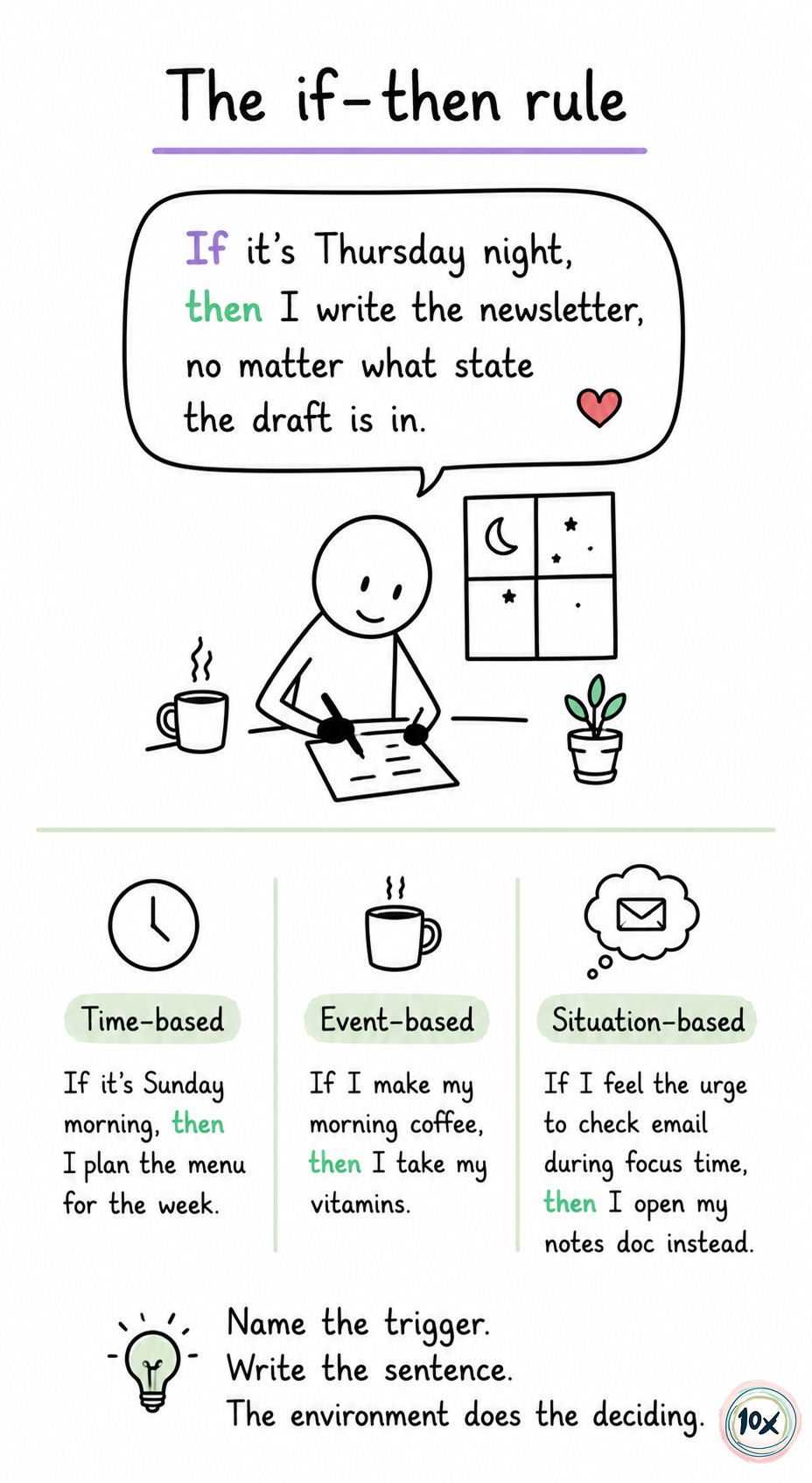
For over four years, this newsletter has gone out every Thursday. No skips. People sometimes ask me how. The honest answer isn't discipline. It's a sentence I made a long time ago: “If it's Thursday night, then I write the newsletter, no matter what state the draft is in.” On Thursday nights, I don't decide whether to write. I already decided in advance.
That sentence is called an implementation intention. It's one of the most-researched, least-used tools in cognitive psychology.
We overthinkers are excellent at deciding. We consider the options. We weigh the trade-offs. We make good, careful decisions.
Then the decision sits there. And nothing happens.
We meant to run. We meant to write. We meant to have the conversation. We meant to make the call. Each morning arrives with the intention intact and each night arrives with the intention still intact and unexecuted. 😅
The gap between deciding and doing is the largest gap most overthinkers live with. And the reason it’s so hard to close has almost nothing to do with willpower.
How it works
The formula is one sentence:
If [specific situation], then I will [specific action].
The situation needs to be concrete and environmental. A specific time. An existing habit. A physical location. Something you can point at that will predictably happen.
The action needs to be specific and executable in the moment. Not “exercise.” Not “call more often.” It should be one clear thing you can do without deciding again.
That’s it. Just this one sentence. No motivation required. No willpower required. The environment does the deciding.
Why it works
Peter Gollwitzer at NYU has spent decades studying this. His research shows that people who form implementation intentions execute their goals at 2 to 3 times the rate of people who just set the goal.
Same goal. Same person. Different execution rate.
The mechanism is simple. When you set a generic goal (“I’ll run more), you have to decide, every day, whether today is the day. That decision uses willpower. Willpower is depletable. Some days you have it but most days you don’t.
When you form an implementation intention (“If it’s Tuesday 5:30 p.m., then run), you’ve already made the decision. Tuesday evening arrives, and there’s nothing to decide. The environment triggers the action.
You’re not stronger. You’re just no longer required to be strong at 5:30 p.m. on a Tuesday.
Three types of if-then rules
❶ Time-based. “If it’s Sunday morning, then I plan the menu for the week.” Best for habits you want to run on a schedule.
❷ Event-based. “If I make my morning coffee, then I take my vitamins.” Best for stacking a new behavior onto an existing one.
❸ Situation-based. “If I feel the urge to check email during focus time, then I open my notes doc instead.” Best for interrupting patterns you want to change.
The best implementation intentions use the SPECIFIC version of the trigger. “Morning” is too vague. “8:00 a.m., kitchen, coffee brewing” is a trigger. The more specific the situation, the more automatically the action fires.
When to reach for it
Reach for it when:
You’ve been “meaning to” do something for weeks or months
The goal is clear but the execution keeps slipping
You’re waiting for motivation that isn’t arriving
The activity keeps losing to whatever else is in front of you
Skip it when:
The decision itself is what’s unclear (this is an execution tool, not a decision tool)
The action genuinely requires context-sensitive judgment each time
The behavior is a one-off (this tool is for repeat behaviors)
The reason overthinkers benefit disproportionately from this tool is that we’re excellent at deciding and unreliable at executing. Implementation intentions transfer the deciding to a moment when you’re calm, and hand the executing to a moment when you don’t have to think about it.
Motivation is a feeling. Willpower is a battery. Triggers are neither. If you can name a trigger, you can build the habit.
Write the sentence. Read it back. See if the trigger is specific enough that it fires on its own.
If it is, you don’t need discipline anymore. You just need Thursday night to arrive.
"For over four years, this newsletter has gone out every Thursday. No skip" - Super Inspiring !
If-then is a great strategy for inspiring action without decision-making fatigue! It's also a tool I use to combat worrying, especially for upcoming races. If (this happens), then (I will). No more worrying about what-ifs. If this happens, then I will do this. :)