

Thinking with three ANDs
The quickest mental tool to test planning vs avoiding

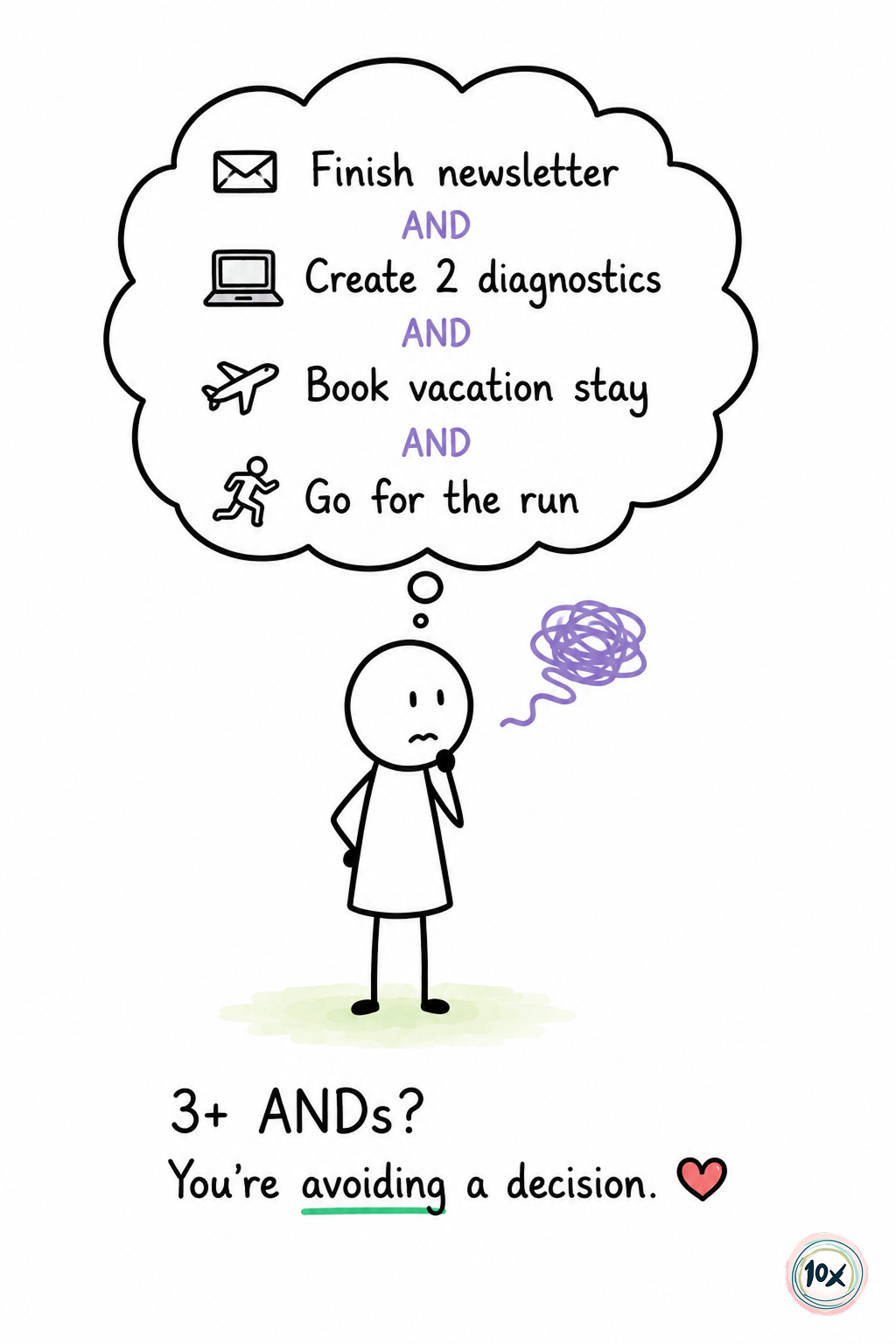
My first thought this morning was a plural. I need to finish the newsletter AND create two website diagnostics AND book a stay for our upcoming vacation AND go for the run I skipped yesterday. By 10:00 a.m., I’d done none of them properly. I’d started three, half-finished each, and felt worse than if I’d done nothing.
This is the three ANDs test.
It’s the simplest mental tool I know for the moments when I’m trying to please everyone, or do everything, or hold too many priorities in my head at once.
Here’s the test.
When you catch yourself in a spiral, listen to the sentence in your head. Not what you’re doing. What you’re telling yourself you should be doing. Count the ANDs.
If there are three or more, you’re not planning. You’re avoiding a decision.
What’s actually happening
Every “AND” in the sentence pretends that two things carry equal weight. But most times, one of them is actually the priority, and the others are the ones you’re refusing to sideline.
Trying to hold them all equal is the trap. The sentence “I want X AND Y AND Z AND W” isn’t a plan. It’s a way of refusing to pick.
The refusal feels responsible. In a culture that rewards multitasking and busyness, saying “I want to do all of this” sounds virtuous. Saying “actually only one of these matters today, the other three can wait” sounds lazy or unambitious.
But your day has finite hours. Your attention has finite depth. If you try to do three things well, you’ll do all three poorly. If you try to do four, you’ll do four poorly. The math doesn’t change because the sentence is aspirational.
How I noticed it
I started seeing this pattern a few weeks ago while writing a thinking-pattern insights report for a Pinwheel user, with her permission.
One signal kept showing up: sentences with three or more ANDs. Every time one appeared, it marked a moment where she was stuck between competing priorities she was refusing to prioritize.
Once I discovered the pattern in her thinking, I started seeing it in mine. All the time! And in almost every friend I paid attention to.
The word “AND” in your own head is a warning sign. You don’t need any other diagnostic. Just count.
Three signs the ANDs are the problem
❶ Your sentence has three or more ANDs.
❷ You feel exhausted before you’ve started any of them. The list itself is the fatigue.
❸ You can’t actually commit to which one you’ll do first. Each one keeps swapping with the others in your head.
The three-ANDs sentence feels realistic. “I have many things I care about.” “I have a full life.” “I’m ambitious.”
None of that is wrong. But when the sentence turns into paralysis or half-done days, the ambition isn’t serving you. It’s serving as cover for the harder question we’re not asking.
The harder question: if I could only do ONE of these today, which one would it be?
Priority isn’t the same as importance.
Four things can all be important. Only one can be the priority right now.
Three ANDs in your head mean you have three priorities, which means you have none. The word AND is a warning that you’re spreading your attention too thin because concentrating it would require a choice you don’t want to make.
Count the ANDs. Then pick one.
That kind of three-ANDs-in-your-head moment is what I built Pinwheel for: a WhatsApp thinking partner that catches you mid-loop and names what's actually happening. Unlike most AI, it doesn't soften the read to please you. When you're stuck in your head, the last thing you need is something that agrees with you.
Free during beta. If you try it, I’d love to hear your experience. ❤️