

Worrying, thinking, and a mental tool to tell the two apart

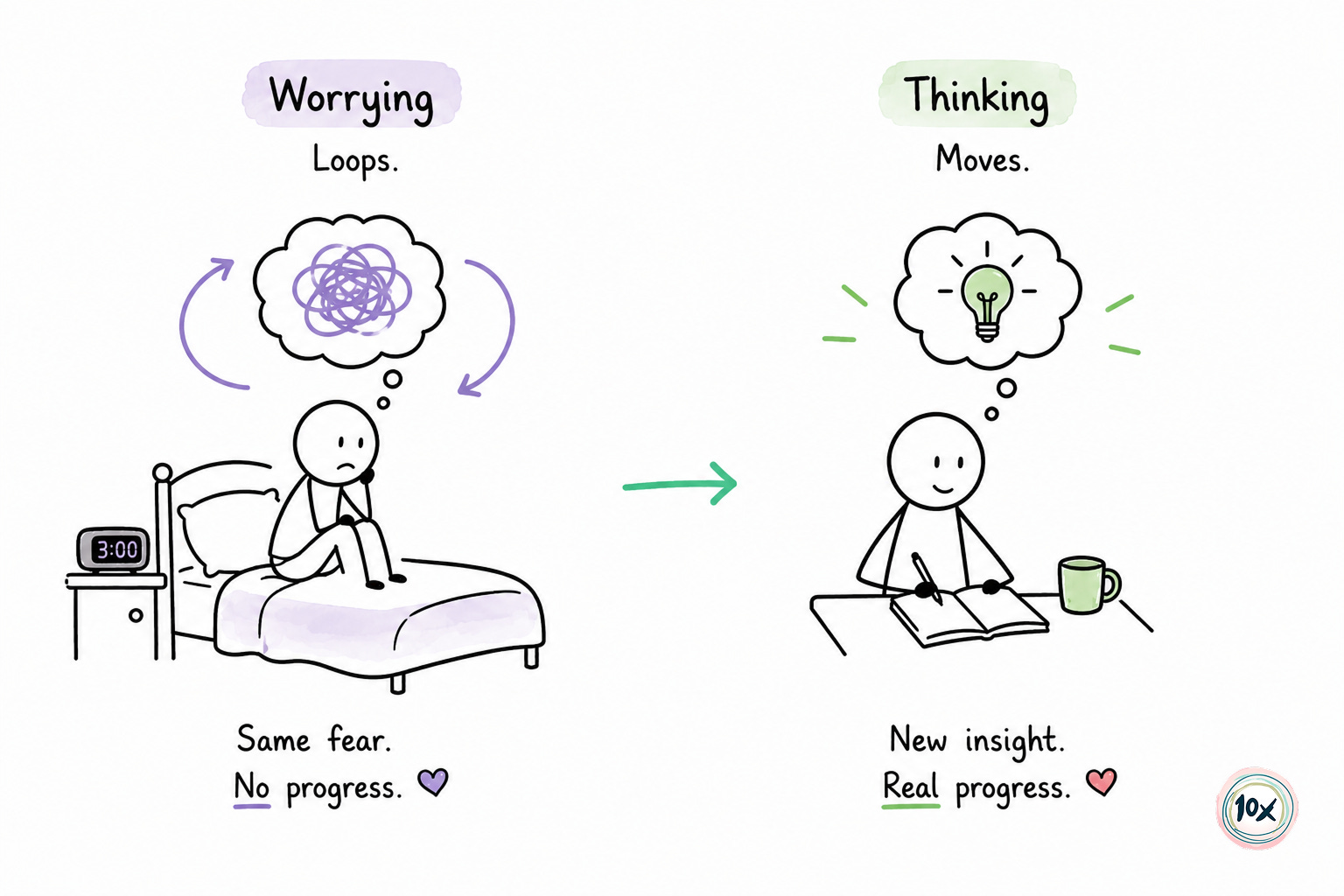
Sometime last week, I woke up at 3 a.m. with a thought about my daughter. Within twenty minutes, I was in a full mental flight about a hypothetical future where she made a bad choice. Even though there was no real problem, my brain manufactured a crisis that it felt compelled to fix.
That was worrying, not thinking. The trouble is that in the moment, they look almost identical.
The same brain that does your best work also runs the worst kind of loop. And in the middle of either one, it’s hard to tell which mode you’re in.
What’s actually happening
Thinking is generative. It moves. At the end of a real thinking session, you have something you didn’t have at the start: a piece of new information, a tentative decision, a clearer question, a better-shaped argument, a written conclusion. Thinking outputs something. You can point to it.
Worrying is recursive. It loops the same fear, in slightly different phrasings, with no new output. At the end of a worrying session, you have what you started with: the same fear, refreshed. You feel like you’ve been working. The brain has been running. But nothing has actually moved.
Same machinery. Same focused attention. Same hours of your evening. Different output.
The reason we mistake one for the other is that in the moment, the texture is similar. You’re focused. You’re not distracted. You’re “engaging with the problem.” It feels active. Worry borrows the costume of thinking and walks around in it for hours.
The bill comes later, usually when you’re tired and the situation hasn’t moved.
Three signs you’re worrying, not thinking
❶ At the end of the session, you can’t point to what you’ve produced. Not a decision, not a piece of new information, not a clearer question. Just the same fear, slightly rearranged.
❷ The same fear is on its fourth or fifth replay in the same session. Thinking moves to new questions, whereas worry refreshes the old ones. If you’ve thought “but what if X” four times in twenty minutes, you’re not thinking. You’re holding the fear.
❸ You feel worse at the end, not clearer. Even hard thinking usually produces some sense of progress, because the brain registers itself as productive. Worry produces fatigue without progress. The body knows.
A simple test
When you’re not sure which mode you’re in, ask one question:
What new information do I have now that I didn’t have ten minutes ago?
If you can answer in a sentence: you were thinking. Carry on.
If you can’t answer, or the answer is “nothing”: you were worrying. The next ten minutes won’t give you any more than the last ten did. Time to put it down.
The honest answer is often “nothing.” That’s the data. It doesn’t mean you’re broken. It means the loop has run its course and your brain is just keeping itself busy on the same fear. Naming it is the exit.
Thinking has an exit. Worry doesn’t, because it isn’t going anywhere. It’s circling.
The skill isn’t shutting off your worry. It’s recognizing which mode you’re in within the first ten minutes, and knowing that worry doesn’t deserve another forty-five minutes of your evening just because it’s loud.
Worry will always ask for more time. Don’t keep giving it to it. Give it the test instead.
That kind of looping-without-progress mode is what Pinwheel was built for: a WhatsApp thinking partner that catches you mid-loop and names what’s actually happening. Unlike most AI, it doesn’t soften the read to please you. When you’re stuck in your head, the last thing you need is something that agrees with you.
Free during beta. If you try it, I’d love to hear how you find it. ❤️