

Replaying
Why overthinkers keep replaying a moment that's already done.

A couple of years ago, I got interested in a new skill and did what I always do when something catches my mind: I went all in at the beginning.
I found a course, made notes, stayed up late watching tutorials, and felt that specific kind of excitement that only comes when you can see a new version of yourself on the other side of the learning curve. For a while, it was clean. There was momentum. There was progress you could point to.
And then I reached the part where the learning stops being private.
The part where you have to build something messy. Something real. Something where you can’t hide behind “I’m still learning.” You have to pick a small project, make a bunch of beginner mistakes in public, and let the work teach you what the course can’t.
That’s where I stalled.
I didn’t stall dramatically. Not with a conscious decision. Just a soft fade-out: I finished the course, told myself I’d “start a project soon,” and moved on to the next interesting thing.
At the time, it didn’t feel like failure. It felt like life. Like a normal pivot.
But months later, sometimes randomly, while washing dishes, or walking, or opening my laptop, I would feel my mind tug me back to that abandoned fork in the road.
What if I had just done one small project?
What if I had found one real client, even a tiny one?
What if I had stayed with it for six more months?
Nothing new was going to come out of asking those questions. The chapter was closed. The decision (if you can call drifting away a decision 😬) had already happened.
And yet my brain kept returning to it, like there was still something to fix.
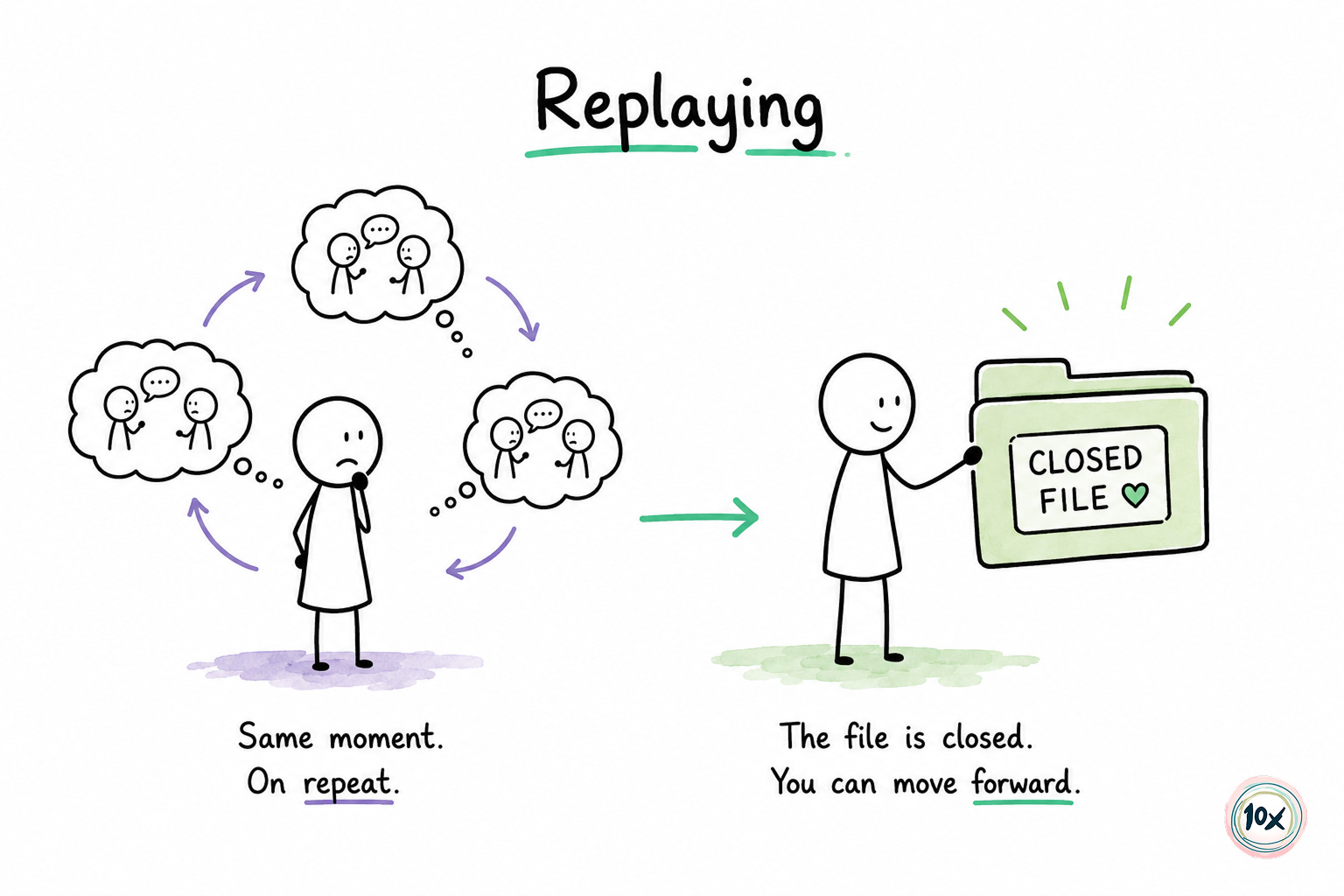
This is the classic Loop Thinker.
The overthinker whose brain treats a closed file as if it’s still open.
The Anticipator runs forward, rehearsing scenes that haven’t happened yet. The Loop Thinker runs backward, replaying scenes that already ended. Same engine, opposite direction.
If you’re one, you know the texture of it.
A conversation ended. The email is sent. The moment has passed. The decision, whatever it was, has already been made in the only way decisions ever get made: by time moving forward.
And still your mind returns to the same five minutes as if the ending could be rewritten.
You know it can’t.
You replay it anyway.
What’s actually happening
Your brain is a pattern-matching system, and it’s very good at its job.
When something emotionally charged happens, like something with stakes, or uncertainty, or a hit of shame, your mind tags it as unfinished. It marks the moment as “needs processing,” and it keeps bringing it back up because, in most situations, that’s useful.
If there’s a real problem to solve, looping can be the mind’s way of staying close to it until a decision is made or new information arrives. It’s the mental equivalent of leaving a tab open because you still need it.
The trouble is that the Loop Thinker doesn’t only loop on open problems. It loops on closed moments.
Moments where there is no decision left to make.
No new information to gather.
No action that can travel back in time and alter the outcome.
Your brain doesn’t always recognize that the file is closed. So it does what it always does when it feels unresolved: it reopens the document and starts reading the same lines again, hoping that this time it will see something it missed.
But it doesn’t.
Each reread feels like thinking. It feels like work. It feels like effort toward resolution.
After the first few passes, it’s mostly a rewatch. The same memory. The same emotional beat. The same internal commentary. The same “if only…” soundtrack playing over it.
Why the seduction
Looping is sticky because it borrows the costume of responsibility.
It can feel like you’re being conscientious. Careful. Reflective. Even moral.
It doesn’t look like avoidance. It looks like engagement. It looks like you’re “dealing with it.”
Actually, there is a version of thinking that is dealing with it.
But the honest answer is this: thinking about something the eleventh time doesn’t add what the third time didn’t.
Past the second or third pass, you’re usually not processing anymore. You’re rehearsing the emotion.
You think, If I keep going over this, eventually I’ll understand.
The first pass helps you make sense of what happened. The second pass helps you catch the pattern. The third pass helps you name what hurt.
After that, the loop often shifts from sense-making to self-contact: it becomes a way of holding the feeling against your skin, again and again, because the feeling still has charge.
It’s not analysis. It’s a nervous system returning to the same hot spot.
Three signs you’re looping, not processing
❶ You can predict the next thought before it arrives.
The loop has a script. You’ve memorized it. You already know what your mind is going to say next, and it says it anyway.
❷ The emotion comes back at full intensity every replay.
Processing usually reduces charge over time. A loop often refreshes the charge, like pressing “replay” on the feeling itself.
❸ When the loop ends, nothing has actually moved.
You don’t have a clearer next step. You don’t have a conclusion. You don’t even have a gentler relationship with the moment. You just feel wrung out, like your brain ran for miles and still ended up in the same place.
A small break
When you notice you’re looping, try something deceptively simple.
Name what you’re doing in plain language: out loud if you can, or on paper if you can’t:
I’m replaying that conversation.
I’m rereading that email in my head.
I’m running the “what if I had…” version again.
That’s it. Just naming it.
Loops are powered by the brain’s belief that it’s solving something. Naming the loop gently tells the brain: We both know there’s nothing to solve here.
It won’t always stop the loop. But it often changes the texture. It removes the disguise. And when the disguise drops, the loop sometimes loses speed.
If naming isn’t enough, go one layer deeper and ask a smaller, truer question:
What is this loop protecting me from feeling?
or
What is this loop letting me avoid?
Looping is a soft way of staying close to a hard feeling without moving toward the hard thing the feeling is pointing at: an apology, a boundary, a decision, a repair, a letting go.
Sometimes the loop isn’t asking for more thought. It’s asking for a different kind of courage.
The reframe
Loop Thinkers are often told to “let it go” or “move on,” but that advice misses what’s actually hard.
You don’t loop because you chose to.
You loop because your brain is doing what it evolved to do: keep working on the thing until it’s resolved.
The trouble is that some moments don’t have a resolution. They just have an ending.
So the skill isn’t shutting down the loop with willpower. It’s learning to recognize the difference between:
a thought that is still earning its keep, and
a thought that is simply running because the brain hasn’t been told the file is closed.
A useful question mid-loop is:
Has this replay added one new thing in the last three passes?
If the answer is no, the file is closed. Your brain just hasn’t gotten the memo.
Loops don’t end because you solved them. They end because you stopped feeding them.
Your brain will hand you the same five minutes for as long as you keep reading them. The moment you put the file down is the moment the loop runs out of fuel.
This is part of why I’ve been building Pinwheel: a WhatsApp tool for moments when you’re stuck mid-loop. It does, at small scale, what this essay does at large: it names what your brain is running, then offers a different angle. If you’ve ever wished you could text a friend at 3 am mid-replay and get an honest read instead of more advice, that’s the shape.
Free during beta, no signup:
Say hi to Pinwheel. Bring it whatever’s looping. If you try it and it does or doesn’t help, I’d love to know.
P.S. This is the second of three deep-dives on the overthinker patterns I named last month. Pre-living was part 1 (the Anticipator). Part 3 (the Stuck Decider) is next week. If you had a Loop Thinker moment this week, hit reply and tell me. I’m collecting stories.
Until next time 🙌