

4 years 🥳 and stalling
Why some overthinkers keep choosing not to choose.

4 years. 210 Thursdays. 210 editions. No skips. Welcome to edition 210, a special one because this newsletter turned four years old this week.
If you’ve been here from the beginning, thank you for staying. If you joined recently, thank you for landing here. What you’ve given me, across all these years, is space in your mind. That’s a rare thing to ask of someone, week after week, and I feel it every Thursday. ❤️
The other thing these four years have done: they’ve quietly turned me from a writer into a builder. Somewhere along the way, writing every week about thinking patterns, I realized how many of us are overthinkers. This newsletter, in retrospect, was an act of helping myself turn the “over” part of my own thinking into clarity. Pinwheel is what came out of that work.
A reader once said to me:
“It’s good to read about the mental tools you write about. But sometimes I wonder what ALL I need to consider when I’m actually deciding something in the moment. If I keep considering every point of view, I’ll stay stuck.”
A fair confusion. A typical Stuck Decider one. Which is what today’s edition is about.
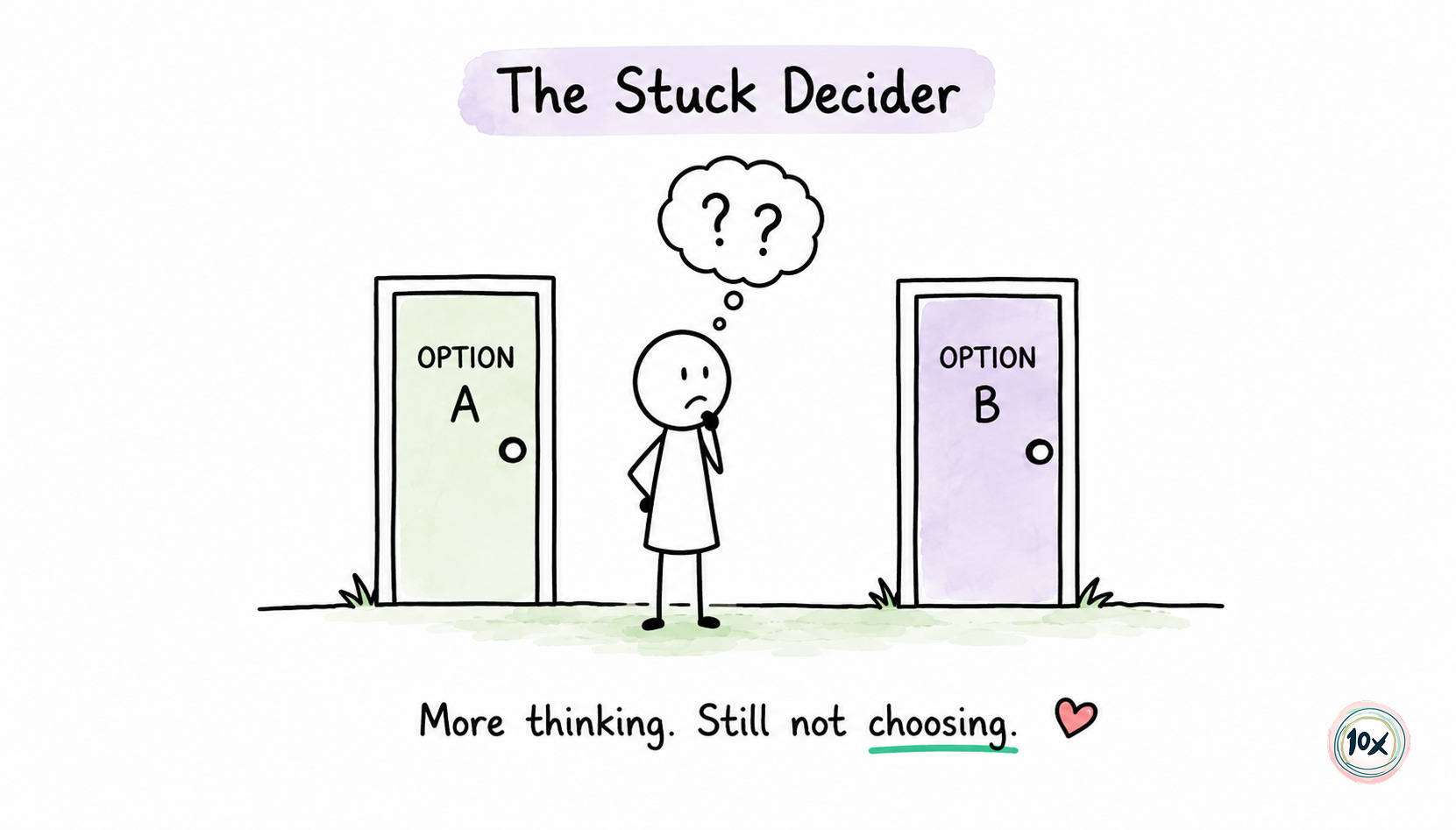
Some of us live in the future: The Anticipator. Some of us live in the past: The Loop Thinker. Some of us don’t move at all: The Stuck Decider.
The Anticipator runs forward, rehearsing futures that haven’t happened. The Loop Thinker runs backward, replaying scenes that already ended. The Stuck Decider stands in front of two doors and studies the doorknobs.
There are two options, sometimes three. We keep analyzing. We keep listing pros and cons. We keep imagining the chain reaction of each, then listing the pros and cons of those. We worry more about what could go wrong than about the cost of delaying.
Of all three types of overthinkers, I think I’m most of a Stuck Decider. (Or am I? I just decided I’m one. Does that make me not one? 😅)
A few weeks back, I spent days deciding whether to offer Pinwheel users insights into their own thinking patterns.
(Quick context: Pinwheel is a WhatsApp tool you message in moments of stuck-ness. Same idea as this newsletter, in real-time, in your pocket. You message like you’d message a friend; it comes back with a clear read on what’s actually happening, plus one concrete next move.)
Imagine if Pinwheel could eventually tell you something like: “You tend to get stuck on trivial decisions and miss the bigger picture.” That’s pattern-level feedback most of us never get.
But here was the catch. Pinwheel doesn’t save user messages. To generate insights, I’d need each user’s permission to access theirs. AI does the actual generation. But I’d review each report before sending, to make sure it landed well. Which means: I could be reading something personal.
Should I even ask users if they want insights? What if asking made people feel uncomfortable and they stopped using Pinwheel altogether? What if no one said yes? What if they hated the idea?
I went back and forth for days.
What if I build the feature and nobody opts in? What if I lose new users to privacy concerns? But also: if it works, it could be a big thing that makes Pinwheel different from general AI. The kind of deep pattern insight ChatGPT doesn’t bother to give.
Pros. Cons. New pros. New cons. Around and around.
I was the Stuck Decider.
What goes on inside the mind of a Stuck Decider
Let’s say you’re stuck between two choices. An unchosen decision keeps both options alive in your head.
As long as you haven’t picked, you still have both. The universe where you took Option A and the universe where you took Option B are both still possible.
The moment you choose, one of those universes goes dark forever.
Your brain knows this. Some part of you isn’t avoiding the wrong decision. It’s avoiding the LOSS of the unchosen. This is regret aversion. You aren’t waiting for clarity. You’re waiting for permission to lose the other option without it hurting.
That permission rarely arrives.
The not-deciding phase feels like “I’m working toward decision-making.”
You’re researching. You’re listing pros. You’re imagining each option at six months out. You’re getting feedback. You’re thinking.
But notice: the research isn’t changing your answer. The list of pros isn’t getting longer with new entries. The feedback hasn’t shifted your lean in either direction for weeks.
That’s the giveaway. Real decision-making moves toward commitment. Stuck-deciding circles the options like a dog deciding where to lie down. Except the dog eventually lies down. We don’t.
3 signs you’re stalling, not deciding
❶ You aren’t actually waiting for new information, just waiting to “feel ready.” The information you’d need to feel ready doesn’t exist. There is no future fact that can make this a sure thing.
❷ The pros-and-cons list hasn’t gained a new line in two weeks. You’re moving items between columns, not adding new ones.
❸ If you had to choose right now with no more information, you’d lean a particular way. You know which way. You’re just not committing to the lean.
How about just “trust your gut”?
Stuck Deciders are often told to “trust your gut” or “just pick one.” That advice misses what’s actually hard.
You’re not failing at courage. You’re protecting yourself from the loss of the unchosen.
The solution isn’t pretending the loss doesn’t exist. It’s deciding which version of you you want to be on the other side of this choice: the one who picked and made it work, or the one who’s still holding the question six months from now.
A useful question, mid-stall: Which option am I more willing to make work?
That’s a different question than which option is “better.” Better is a fantasy of objective truth. Willingness is something you can actually answer.
Pick the one you’d be willing to make work. Then go make it work. That’s how decisions become right after the fact.
Best way to get unstuck: go small
Should I pick job offer A or B? Should I commit to writing the big book I keep postponing? Should I buy the new laptop or wait?
When you’re stalling, ask yourself these two questions in this order:
If I had to choose right now, with no more information, which way would I lean?
What’s the smallest version of this choice I can make today that I could reverse later if I’m wrong?
Most decisions feel binary because we frame them as final. They rarely are.
You can take the new role for a month and revisit. You can write the easy book first and the real one after. You can buy the laptop and return it within thirty days.
Smaller decisions reduce the cost of being wrong, which reduces the freeze.
For my product dilemma, eventually, I did the thing I tell readers to do. I asked Pinwheel.
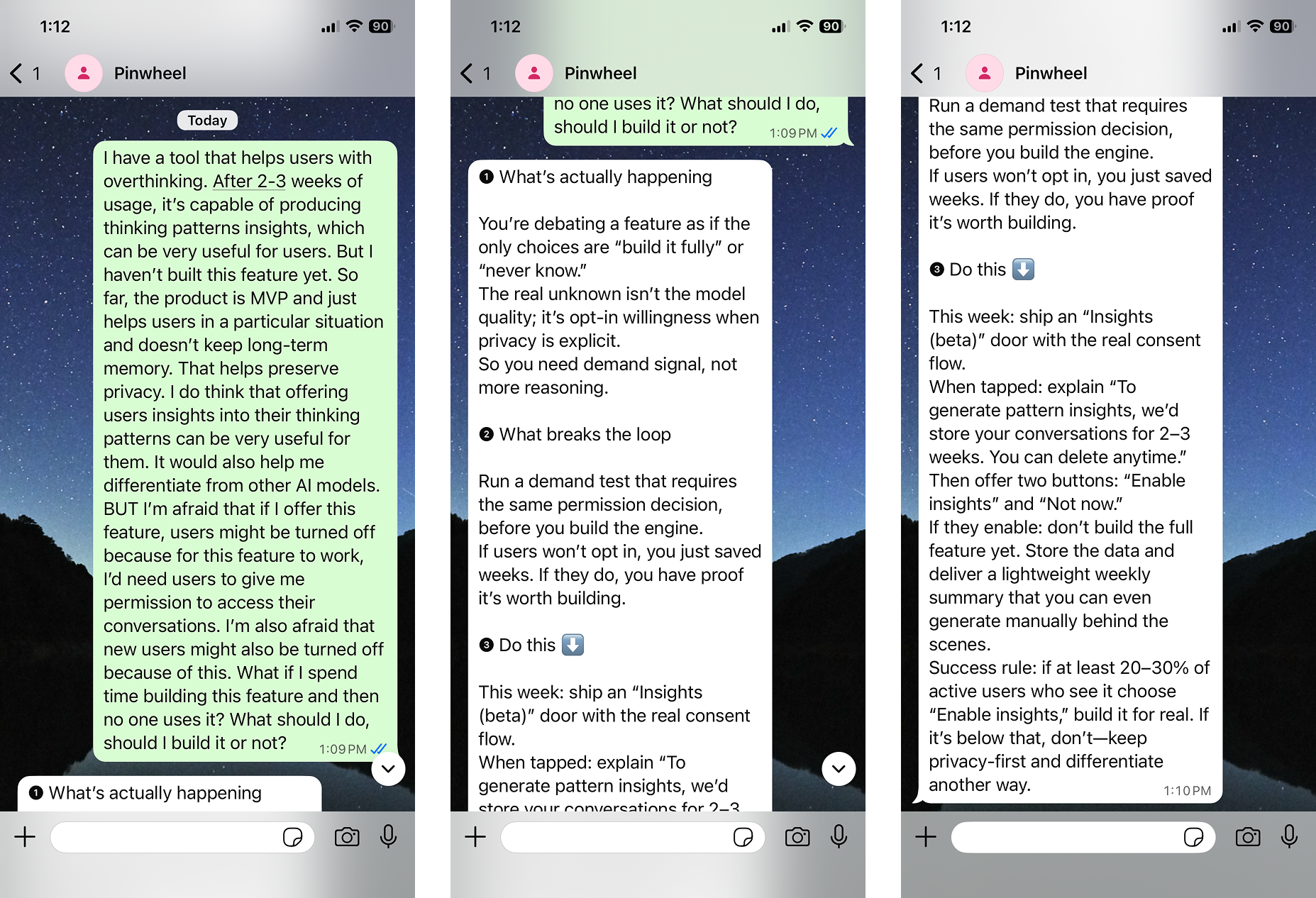
The advice in one line: don’t build the engine before you know there’s demand. Test the smallest version that gets you that signal.
So I did, but even smaller than Pinwheel suggested. I asked one active user if she’d want to see her own thinking-pattern insights. She said yes. I generated them manually and sent them as a one-page PDF. No feature built. She loved them.
That’s n=1. Useful as a signal, not enough to commit. So I want to ask the rest of you who use Pinwheel: would you want insights into your own thinking patterns? Reply to this email and let me know. They’d be for your eyes only.
If you haven’t tried Pinwheel yet, the link is here: pinwheel
Here’s to year 5: more clarity, less stuckness.
Let’s think clearly, not less. 🙌